First record 08.06.2002 Urbanavichus G. LID11898 (KPABG)
First publication Dudoreva T. et al. (2014) (?). Local IUCN category EN .
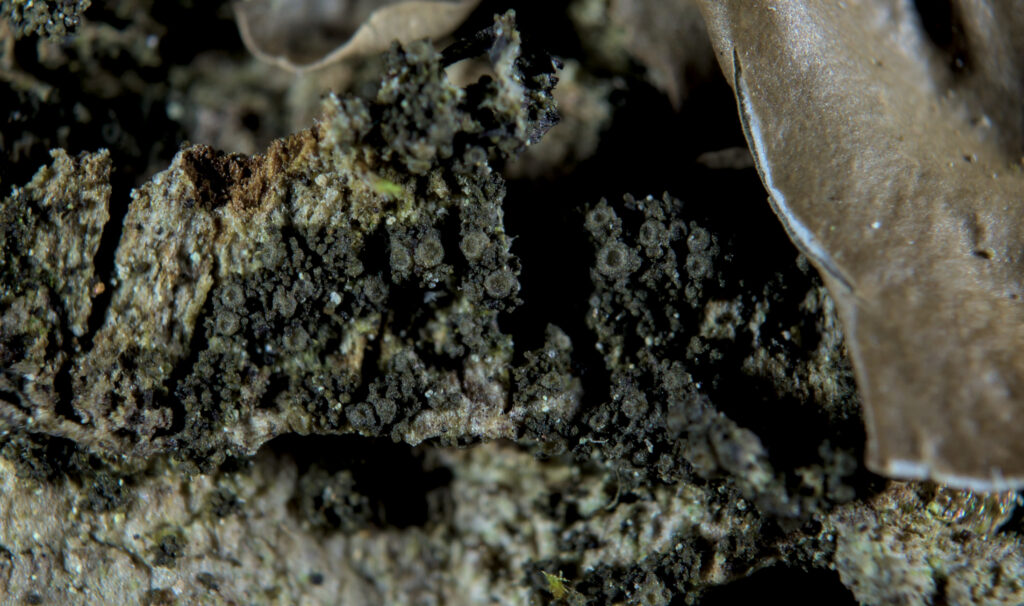
Current name Scytinium fragrans (Sm.) Otálora et al. (Westberg et al., 2021)
Synonims
Morphology (according to Nimis P.L. (2025)). Thallus small-foliose to subsquamulose, homoiomerous, slightly gelatinous when wet, to 0.5 cm in diam., but individual thalli often crowded and covering larger surfaces. Lobes 0.3-1.5(-2) mm wide, up to 400 µm thick when wet, forming neat, more or less stellate rosettes or small pillows, more or less channelled, not swollen, often crenate, adpressed or ascending, dark olive-green to blackish, sometimes with globose, isidia-like papillae or flattened lobules along the margins and on upper surface. Upper and lower cortex absent (but sometimes a fragmentary, poorly developed pseudocortex may be present, especially on lower surface). Apothecia common, lecanorine, crowded in the centre of thallus, 0.4-0.7 mm across, at first immersed, then sessile and constricted at base, with a concave to flat disc, a thin to moderately thick, sometimes papillose thalline margin and a paler parathecial ring. Thalline exciple ecorticate or partly pseudocorticate; proper exciple euparaplectenchymatous; epithecium brownish; hymenium colourless, 80-110 µm high; paraphyses simple or sparingly branched, 1-1.5 µm thick at mid-level, progressively widening towards the apex; hypothecium yellowish. Asci (4-)8-spored, cylindrical-clavate, the apex strongly thickened, the apical dome K/I+ pale blue, with a downwardly projecting K/I+ deep blue tubular structure. Ascospores submuriform to muriform, with 2-5 transverse septa and 2-5 longitudinal septa, hyaline, oval or ellipsoid, 16-30 x 8.5-17 µm. Pycnidia frequent, globose. Conidia bacilliform, slightly swollen at both ends, 4-6 x c. 1 µm. Photobiont cyanobacterial (Nostoc, the cells in long chains). Spot tests: R-.
Ecology.
Note.
References
Dudoreva T.A., Konoreva L.A., Melekhin A.V., Petrova O., Urbanavichene I.N., Urbanavichyus G.P., Fadeeva M.A. Lichens // Red Data Book of the Murmansk Region. 2nd ed., revised and enlarged. 2014 pp. 104-186.Nimis P.L., 2025. ITALIC - The Information System on Italian Lichens. Version 8.0. University of Trieste, Dept. of Biology, ( https://italic.units.it/ ), accessed on 2025, 01, 31. for all. All data are released under a CC BY-SA 4.0 licence.
Westberg M., Moberg R., Myrdal M., Nordin A., Ekman S. 2021. Santesson′s checklist of Fennoscandian lichenforming and lichenicolous fungi. Uppsala: 933 p.