First record undefined.
First publication Kari L. (1936). Local IUCN category LC .
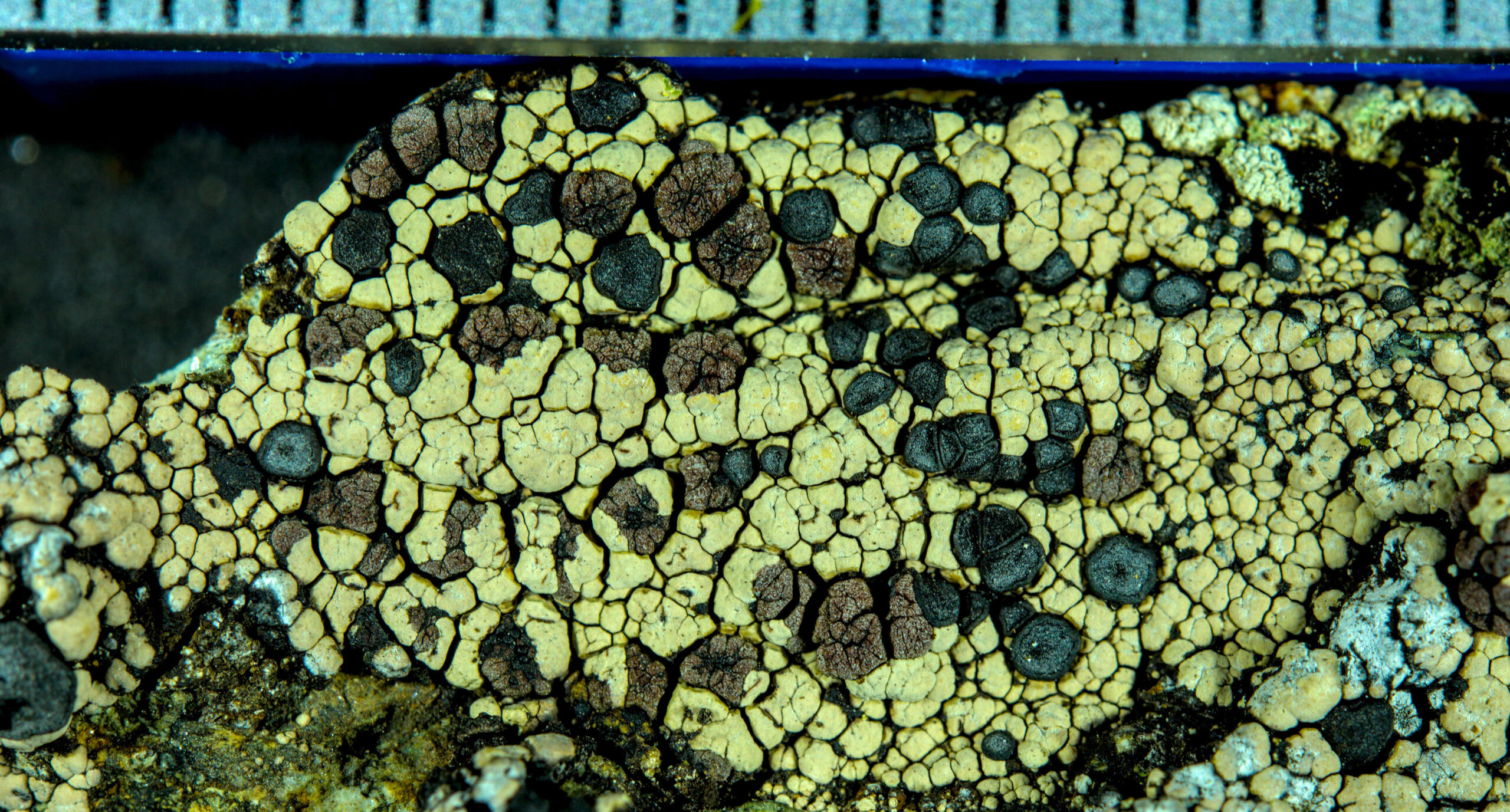
Current name Amygdalaria elegantior (H. Magn.) Hertel & Brodo (Westberg et al., 2021)
Synonims
Morphology (according to Thompson J. (1984) with minor additions and changes). Thallus ashy or waxen, yellowish white to pinkish or yellowish pink, over a black hypothallus, crustose, 1-2 mm thick, bullate-areolate, the areolae to 2 mm broad, often fissured, the exterior areolae often very rounded, the central ones more angular; esorediate; large cephalodia granular, red to waxy brown with Gloeocapsa. Apothecia common, sometime pruinose, usually between the areolae, 1-2.5 mm broad; margin thick, persistent, flexuous to angular, sometimes becoming immarginate; exciple thin, black, shining; epithecium olive-brown, inspersed, excipular tissue blue-green, laterally on apothecium, brown-black or red-brown below, grading into hypothecium; subhymenium 50 µm, red-brown below to pale above; hymenium to 185 µm, hyaline; paraphyses conglutinate, slightly branched, only slightly thickened above to 2.5-3.5 µm; spores 8, biseriate, simple, hyaline, ellipsoid, halonate, 18-35 X 7-16 µm. Spot tests: cortex K- or K+ yellowish, C+ red, KC+ red, medulla K-, P+ weakly orange in spots, C-, I- or rarely I+ weak blue
Ecology. On frequently wetted rock surfaces (near rivulets, snowbeds etc.).
Note.
References
Kari L. 1936. Beitriige zur Kenntnis der Flechtenflora Lapplands mit besonderer Beriicksichtigung der Erd- und Steinflechten auf Fjelden // Ann. Univ. Turkuensis. 1936. Ser. А. Vol. 4, N 6. 35 p.Thompson, J., 1984. American Arctic Lichens: The Macrolichens. (via lichenportal.org: https://lichenportal.org/ )
Westberg M., Moberg R., Myrdal M., Nordin A., Ekman S. 2021. Santesson′s checklist of Fennoscandian lichenforming and lichenicolous fungi. Uppsala: 933 p.