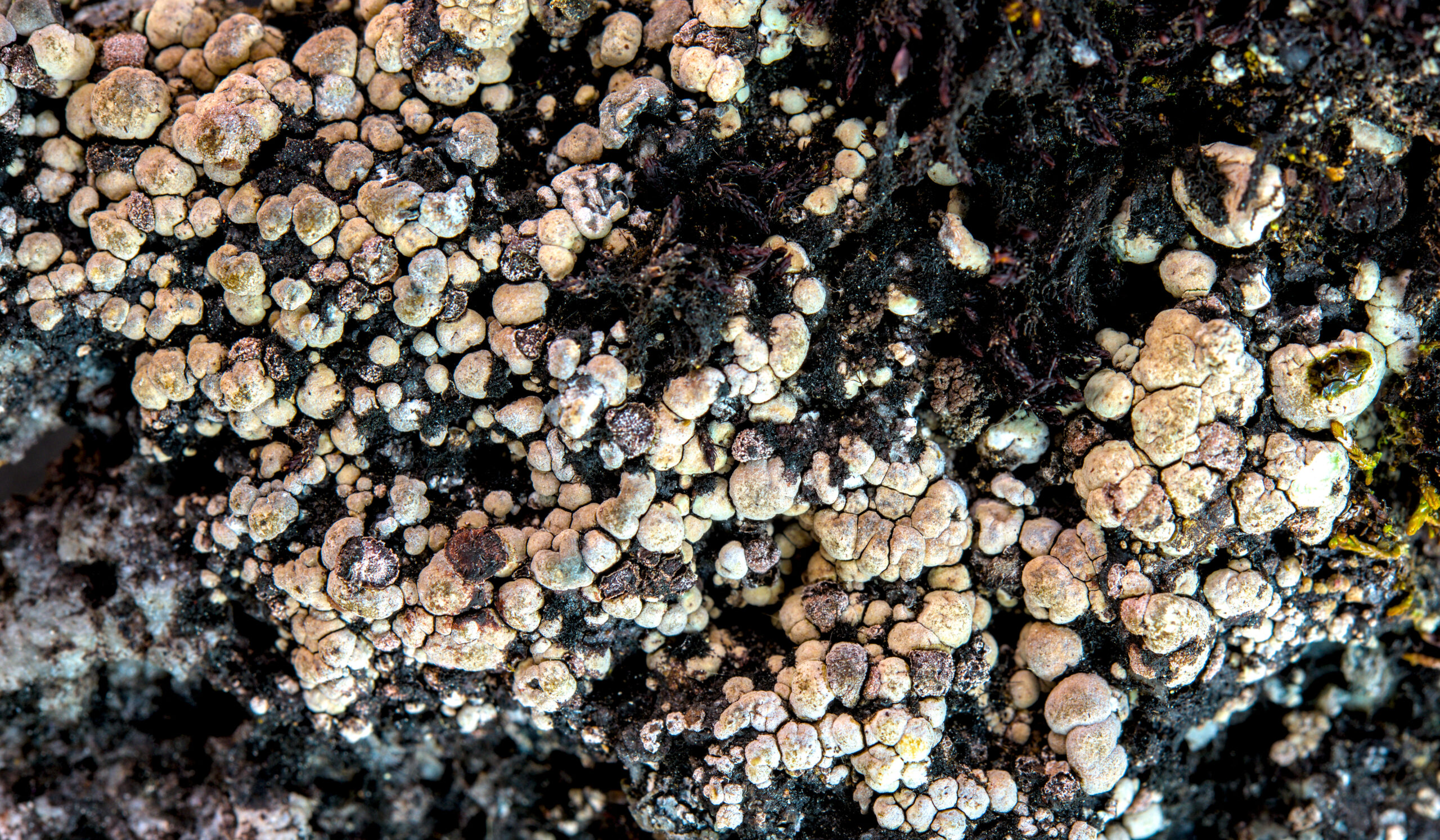
Current name Amygdalaria subdissentiens (Nyl.) Mas. Inoue & Brodo (Brodo, I. & H. Hertel., 1987)
Synonims
Morphology (according to Brodo, I. & H. Hertel. (1987) with minor additions and changes). Thallus with yellowish or creamy tones predominating: pale orange-yellow to pale yellow-brown to brownish gray or brownish pink; areolate to verrucose, bullate, the areoles convex, often becoming lobate, 0.6-2.0(-3.0) mm diam.; thallus margin indefinite; prothallus absent; cephalodia always present and usually large and conspicuous, variable in texture and color, most frequently brownish-gray, occasionally blue-gray pruinose, containing Stigonema, but sometimes with smooth to “brain-like” pink cephalodia (containing Gloeocapsa) on the same thallus, immersed between areoles, hemispherical. Apothecia (material from Khibiny without apothecia) immersed in depressions in areoles forming a pseudo-lecanorine margin, but occasionally flush with surface, 0.4-0.9-1.6 mm diam., black, sometimes somewhat pruinose; proper exciple thin, inconspicuous; hymenium 160-180(-210) um; epihymenium brownish olive to olive; proper exciple thin laterally, rarely thick; hypothecium black, distinct, bowl-shaped; spores 19-24.0- 29.5 x 9.5-12.5-14.5 um, wih a compact or diffuse gelatinous epispore. Spot tests: medulla and cortex KC-, C- or C+, K+ yellow, P+ red.
Ecology. On frequently wetted rock surfaces (near snowbed). In America grows “On shoreline rocks in or just above the salt-spray zone, as well as on exposed alpine ridges.” (Brodo, I. & H. Hertel.,1987) – apparently this species requires rich mineral nutrition.
Note. Differs from similar Amygdalaria pelobotryon by positive reaction on P (P+ red) and more bullate areoles.
References
Brodo, I. M. & H. Hertel. 1987. The lichen genus Amygdalaria (Porpidiaceae) in North America. Herzogia 7: 493-521.The taxon in local projects: