First record 1861 Karsten P. (Dombrovskaya, 1970). Last record 13.08.2023 Melechin A. LID144148(KPABG).
First publication Nylander W. (1882). Local IUCN category LC
Current name Lobaria pulmonaria (L.) Hoffm. (Westberg et al., 2021)
Synonims
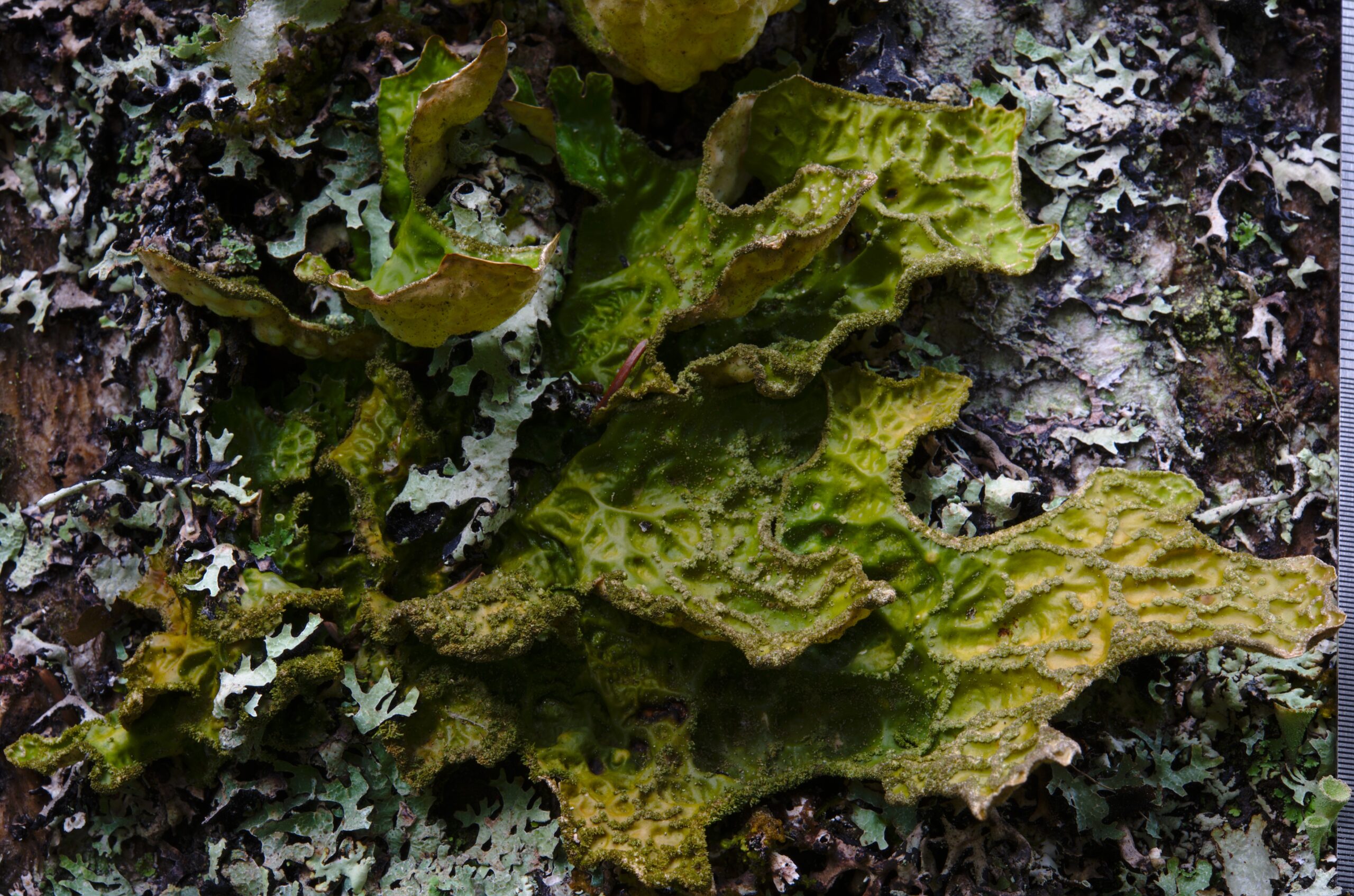
Morphology (according to Nimis P.L. (2025) with minor additions and changes). Thallus foliose, heteromerous, dorsiventral, broad-lobed, up to 0.5 mm thick, loosely attached at one end, sorediate and/or isidiate. Lobes broadly strap-shaped, 1-3(-5) cm wide, more or less dichotomously divided, at first adpressed, then mostly free from substrate in apical parts, the apices truncate, sinuate-indented; upper surface grey-green to yellowish brown, dull or slightly glossy, bright green when wet, strongly reticulately ridged, with marked depressions. Isidia or granular soredia often present along margins and on ridges, the isidia cylindrical to club-shaped, more rarely flattened, often branched, to 0.4(-2) mm long when terete, the soralia developing where the isidia were shed, discrete to patchily confluent, punctiform to linear, with mostly coarse, globose, 20-70 µm wide soredia, often gathered into up to 80 µm wide consoredia. Lower surface white to pale brown at margins and on the swellings corresponding to the depressions on upper surface, otherwise pale to dark brown, tomentose, except on the swellings, mostly erhizinate or with sparse, at first squarrose, then simple rhizines. Medulla white, often with internal cephalodia which are sometimes visible as rounded thickenings on the lower and/or upper side. Apothecia rare, laminal, most frequent on the ridges, 2-5(-7) mm across, with a brown-red disc and a thin, sometimes finally excluded, initially minutely hairy thalline margin. Epithecium reddish brown; hymenium colourless or pale brown in lower part; paraphyses mostly simple, not capitate; hypothecium brownish. Asci 8-spored, clavate, fissitunicate, the thickened apex with a K/I+ blue ring, Peltigera-type. Ascospores (1-)3(-5)-septate, fusiform to narrowly ellipsoid, hyaline to pale brown at maturity, (16-)18-30(-37) x 5-9 µm. Spot tests: upper cortex K-, C-, KC-, P-; medulla K+ yellow-orange (often faintly), C-, KC- or KC+ yellow-orange, P+ faintly orange-red.
Ecology. Usually it is epiphytic lichen but sometimes grows on rocks.
Note.
References
Dombrovskaya A. V. Konspekt flory lishainikov Murmanskoi oblasti i severo-vostochnoi Finlyandii [A checklist of lichens of the Murmansk Region and northeast Finland]. Leningrad: Nauka, 1970. 117 p.Nylander W. 1882 (1867 but in journal 1882). Lichenes Lapponiae orientalis. - Notiser Sallsk. Fauna Fl. Fenn. Forhandl. 8. P. 101-192.
Nimis P.L., 2025. ITALIC - The Information System on Italian Lichens. Version 8.0. University of Trieste, Dept. of Biology, ( https://italic.units.it/ ), accessed on 2025, 01, 31. for all. All data are released under a CC BY-SA 4.0 licence.
Westberg M., Moberg R., Myrdal M., Nordin A., Ekman S. 2021. Santesson′s checklist of Fennoscandian lichenforming and lichenicolous fungi. Uppsala: 933 p.